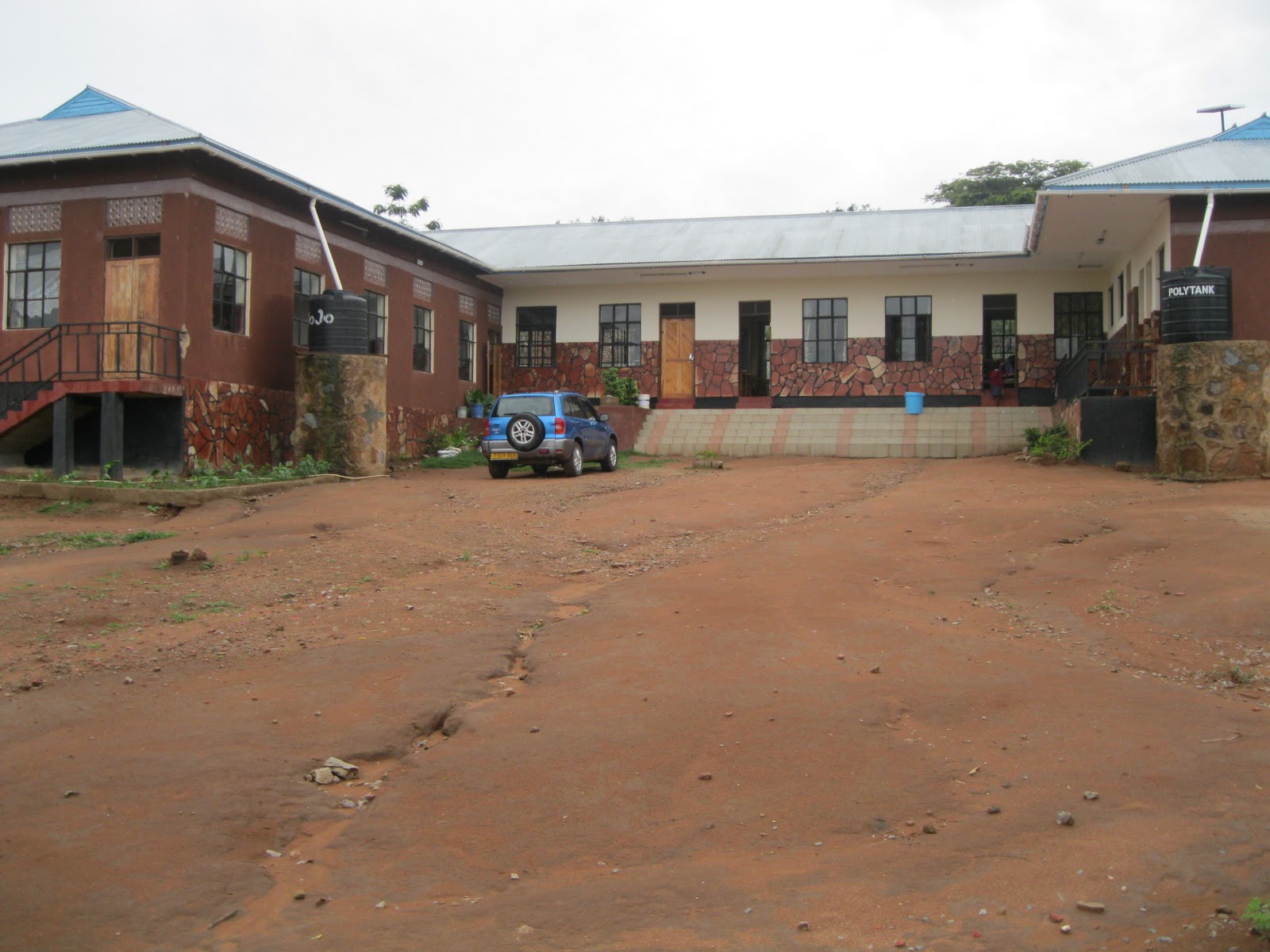
On Wednesday, November 11, I had the honor to visit a Women’s Center tucked in the upper hills of Mwanza known as the area of Nyashana. The center was first designed and pioneered by Father Raymond Manyangu of St. Francis Church Xavier in Mwanza. In addition to serving members of his parish, Father Raymond frequently visits communities that have difficulty traveling to the church due to poor health conditions compounded with aging, roles and responsibilities within the household, and or eroded roads and the expense to travel.
In Nyashana , Father went “to the mountain” and initially served mass under the protection of a large mango tree. With tremendous vision and assistance he was able to develop and create a center that has a protective all-purpose room for serving mass and varied activities.
The vision had a rippling affect, the project needed to serve the women and multiples of children in the area. Manyangu assigned an assistant coordinated, Johanna Sele, a native of Liechtenstein, from his parish. With financial assistance from the parish and donors from all corners of the world, Johanna has designed and implemented life skills’ and educational projects that benefit the members that attend the center.
The projects are as follows:
1. Home craft:
a. instructs neighboring women in healthy cookery and kitchen skills.
b. tailoring program which instructs the members in sewing skills and dress design.
2. Montessori Kindergarten: instructed by licensed educators.
a. provides a creative jump start to the children’s education in the community.
b. trains individuals who show an interest in primary education instruction.
c. meals and a safe environment are provided to further nurture the child participant.
3. Library:
a. characteristically students of primary and secondary education do not have the related texts for their studies; therefore the lending library attempts to provide the texts that are utilized in the government schools. Due to limited additions of each text, it is essential that students utilize the books only at the facility so that all may benefit.
b. Library is monitored by area students who take pride and responsibility in maintaining the library’s order.
4. Medicinal Plants Project: due to challenges in travel and expense and availability of “modern medicine,” the project produces homeopathic remedies derived from plants that are indigenous to the area.
Varied plants, seeds, and leaves that are used have treated the following illnesses successfully – to name a few:
a. boosts one’s immune system to combat malaria and indivduals diagnosed with HIV/AIDS.
b. peptic ulcers
c. curtail one’s diabetes and or high blood pressure
d. soaps are made and decoratively wrapped in a banana leaf for skin concerns.
e. enhance a mother’s milk
All items are prepared and packaged by the women of the center under the supervision of Johanna Sele. Items are sold or provided to members of the community. In addition, items are also sold at the parish store to generate funds for the center and to aid in their goal to be self-sustainable.
Please note that the situation in many developing countries is quite desperate for immediate and proper health care. Early intervention is so essential to everyone’s health globally. However the rising price of medical drugs, modern patenting laws, and the fall in value of local currencies mean that local centers can not afford the luxuries or the cost of basic drugs. It appears that cooperation and collaborative efforts between traditional healers and medical staffing is essential to the successful health care of developing communities.
5. Bracelet Project: 90% of the product is handmade from recycled material. The threads are colorful fishing line. The base of one of the bracelets is the plastic packaging strip found on Red Cross packages. Also, large totes are weaved from the same and colorful plastic strips. Nothing goes to waste. I plan to meet with the women on Wednesday the 16th to introduce the “French” form of knotting tying, macramé. Can’t help myself! I was in awe with their desire to be self-supporting and industrious.
 |
| Modeling the bracelets |
|
 |
Assistant coordinator, Johanna Sele, displaying medicinal seeds and the bracelet project.
|
 |
| Project facility in Nyashana |
 |
Catechist, Tadeus
Laced in the programs is the initial goal of bringing the church to the community; the spiritual leader is catechist, Tadeus. However all denominations are warmly welcomed and encouraged to attend the facility. |
 |
| Cookery Project |
 |
| Head cookery instructor |
 |
| Member sorting leaves to be ground to powder for medicinal purposes. |
 |
| Tailoring project |
 |
| Sewing machines propelled by one's feet. |
 |
| Montessori instructor and pupil |
 |
| Librarian assisting a student utilizing its resources. |
 |
| One shelf library...second one on the horizon! |
 |
| Road leading up to the community in the hills and to the center. Treacherous |